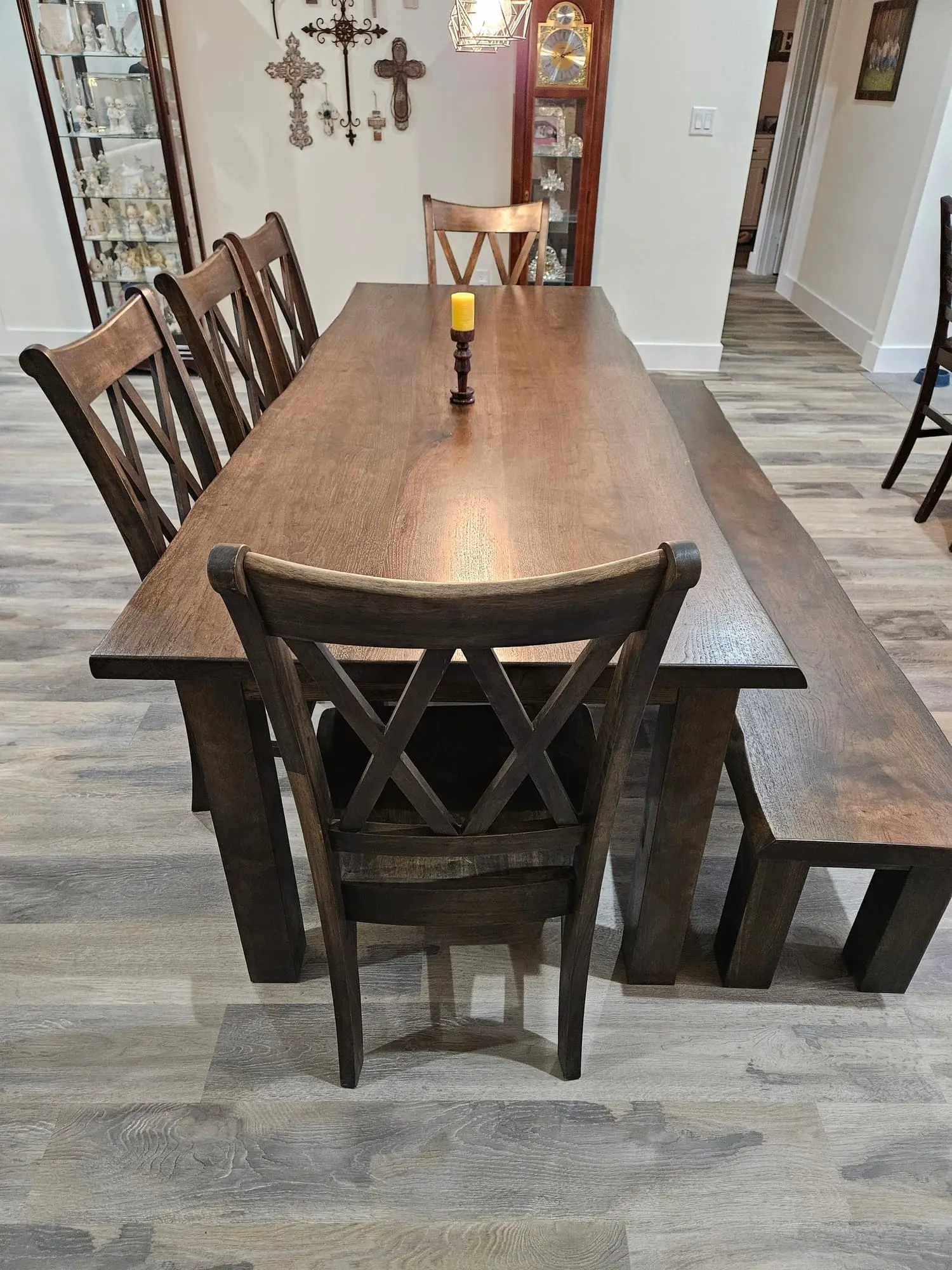
The Sawmill
Most furniture shops buy boards. We make them.
A real sawmill and a kiln on the same ground as the shop. We mill the lumber for our own furniture, and we sell slabs, lumber, and kiln time to anyone who needs it.
Why it matters
What milling on site actually changes
This is not a detail for woodworkers to enjoy. It shows up in the grain of your top, the thickness of it, how it behaves in your house, and what it costs.
We choose the grain
A log can be opened several ways, and each way gives a different face. We cut for the piece we intend to build, not for whatever yields the most board feet.
We choose the thickness
Want a two-inch top instead of an inch and three-quarters? That is a decision at the mill, not an upcharge from a supplier who does not stock it.
Matched boards from one log
A top glued up from boards that grew next to each other in the same tree looks like one piece of wood. A top glued up from a random bundle looks like a bundle.
No mystery lumber
We know the species, the tree, the day it was cut, and what the moisture meter read going into the kiln and coming out. Every board is accounted for, from the log yard to your table.
And the price. Every hand a board passes through adds a margin. Ours passes through two: the log yard and the bench. That is the whole reason a solid hardwood table from a mill can sit next to a veneer table from a showroom at a comparable number.
The vacuum kiln
Wet wood moves. The kiln is how we stop the argument before it starts.
Freshly milled lumber can carry well over half its weight in water. Where that water goes, and how fast, decides whether your table stays flat.
Air drying
- Roughly a year per inch of thickness. Two-inch stock means two years in a stack.
- Dries from the outside in, so the shell can be ready while the core is still wet.
- Bottoms out around the humidity of the yard it is sitting in, which in Texas is not low enough for indoor furniture.
- Months of exposure to bugs, mold, staining, and weather.
Our vacuum kiln
- Under vacuum, water boils at a much lower temperature, so the wood dries fast without being cooked.
- Days and weeks instead of years, which is why a custom species is not a two-year wait.
- Far more even through the thickness. The core comes down with the shell, not behind it.
- Finishes at furniture-grade moisture content, the range an indoor, heated, air-conditioned house actually holds.
- Less movement later: less cupping, less twisting, fewer surprise cracks in year two.
Solid wood still breathes with the seasons after it leaves us, and that part never stops, and it is not a defect. Drying it right just means the movement is small enough to live with. More on that here.
What we sell besides furniture
The mill is open to more than our own benches
If you are building your own piece, framing a custom home, or just have a good log on the ground, we can help with the part in the middle.
Custom milling
Bring us a log or point us at a tree. We mill to your thickness, flat sawn or quarter sawn, and stack it for you. Storm-fallen trees, fence-line clearing, yard trees that had to come down.
Slabs and lumber
We sell to DIYers, hobby woodworkers, and builders. Live-edge slabs, dimensional hardwood, and stock for new and custom homes: mantels, stair treads, beams, shelving, trim.
Kiln drying
Vacuum kiln service on our own schedule. If you have air-dried lumber sitting in a barn at 14% and you need it at 7%, we can finish it properly instead of hoping.
Hand-routed signs
Where Daniel started, and still his favourite work. Letters routed by hand into solid wood, for a house, a ranch gate, a church, or a business.