Hand-Routed Signs and Butcher Block: The Smaller Pieces
Not everything we build is a dining table. A look at hand-routed signs, end grain butcher block, cutting boards, tool handles, and the Patriot Pour Board.
January 15, 2026 · 7 min read
People find us looking for a dining table. A good number of them leave with a sign or a cutting board instead, and come back for the table two years later.
The small pieces are not filler. In some ways they are where the craft shows most, because there is nowhere to hide on something a person is going to hold.
Hand-routed signs
Daniel came to woodworking a little over ten years ago after an event called Quest, put on by Fellowship of the Sword. Of everything he has learned to build since, signs are still the thing he loves most.
Hand-routed means exactly what it says. A router held in two hands, following a layout, cutting letters into solid wood. Not a CNC machine running a file. Not a laser burning a surface. Not vinyl lettering stuck on a board.
The difference is visible if you know to look. A hand-cut letter has slight variation in the wall of the cut, a subtle life to the curves, and a depth that catches shadow differently as you walk past it. A machine-cut letter is perfect and identical every time. Perfect is fine. It is just not the same thing.
It is also unforgiving. There is no undo. A router bit spinning at twenty thousand RPM that wanders outside the line has made a permanent decision, and you start over on a new board. That is why the good ones look easy.
What people order:
- Family name and established-year signs
- Ranch and property signs, the kind that hang at a gate
- Scripture and quotes
- Business and shop signs
- Address signs
- Wedding and anniversary gifts
We cut them from our own hardwood, and we can finish them for indoors or build them to live outside in the Texas sun and weather.
Butcher block countertops
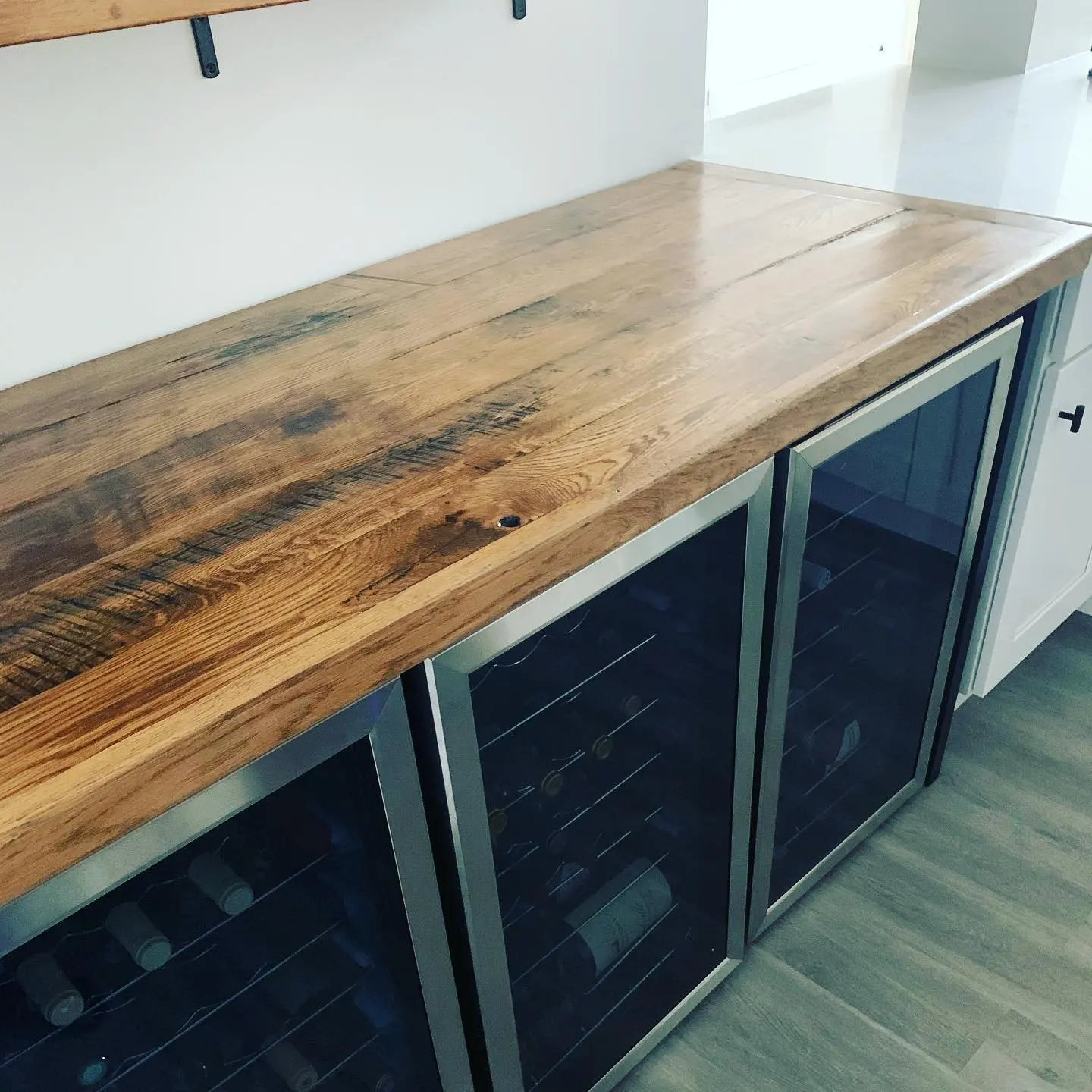
A butcher block counter is a serious piece of work. It is also one of the best values in a kitchen remodel, because unlike stone, you can sand it flat and refinish it in place ten years from now.
There are two constructions and they are not the same thing.
Edge grain is what most people picture. Strips of hardwood glued side by side with the long grain facing up. It is stable, it shows beautiful long grain lines, and it is the practical choice for large countertop runs.
End grain turns the wood so you see the ends of the fibers, like looking down at the top of a bundle of straws. Checkerboard pattern. This is the classic butcher's block, and the reason is that a knife edge pushes between the fibers rather than cutting across them. The wood partially closes back up. It is easier on knives and it hides cut marks. It is also considerably more work to build and it costs more.
Hard Maple is our usual recommendation for anything that gets cut on. It is harder than Red Oak, the grain is closed so there are fewer places for food to hide, and it is the traditional butcher block wood for exactly those reasons. Black Walnut makes a gorgeous dark counter. Red Oak we would steer away from for a cutting surface, since its open pores are better suited to furniture.
Finish matters here. A counter that will be cut on gets a food-safe oil, mineral oil or a hardwax oil, and gets re-oiled periodically. A counter that is decorative or a work surface only, like an island or a bar top, can take a film finish for maximum water resistance.
Cutting boards and tool handles
Owen is the one who got attached to these. Ten-plus years in construction before this shop, and he still likes making something that fits a hand.
Cutting boards come out of the same stock as everything else, which means a cutting board from us might be cut from the same walnut as somebody's dining table. They make excellent gifts, and we can rout a name or a date into them.
Tool handles are a small thing that almost nobody offers anymore. A hammer or a chisel with a handle shaped to your hand out of good dense hardwood is a different tool than the one that came from the store.
The Patriot Pour Board
This one started as a one-off and turned into something people ask for by name.
It is built from a whiskey barrel, staves and all, with the char and the color the barrel earned over years of holding bourbon. It becomes a serving and pour board. The barrel wood brings its own history with it, including the stains and the marks, and that is entirely the point.
No two are the same, because no two barrels are.
Caring for the small pieces
Cutting boards and butcher block that get cut on:
- Hand wash with hot soapy water, never the dishwasher
- Dry immediately and stand it on edge so both faces dry evenly
- Re-oil with food-grade mineral oil when the surface looks dry, roughly monthly at first
- A paste of coarse salt and half a lemon cleans and deodorizes
- Never soak it, never leave it flat and wet
Indoor signs: dust them. That is it.
Outdoor signs: check the finish every couple of years and recoat before it fails rather than after.
What to do with them
The honest pitch is that these are the pieces people give each other. A hand-routed family name sign for a wedding. A walnut cutting board for a housewarming. A Patriot Pour Board for the fellow who has everything.
They are also the way a lot of folks get to know us before they commission something bigger.
Come by and look. We are at 4882 CR 3735 in Wolfe City, Texas, about an hour and fifteen minutes northeast of Dallas, open Monday through Friday 8 to 5 and weekends by appointment. Call 972-837-6974 or email hello@sawwwmill.com.
Small pieces usually turn around faster than furniture, but at Christmas we fill up early. Ask sooner.
While you are here
Every piece we build is made to order in your size, species, and finish, and every board in it was milled and dried here in Wolfe City. Build time runs 4–10 weeks.