Why Solid Wood Moves, and Why That Is Not a Defect
Knots, checks, seasonal gaps, and stain variation are part of owning real wood. Here is what actually happens inside a board, and where we draw the line.
May 14, 2026 · 8 min read
We would rather tell you this before you buy than after.
A solid hardwood table is not a manufactured object that holds still. It is a piece of a tree that is still responding to the room it lives in, and it will keep doing that for as long as you own it.
That is not a flaw in the product. That is the product.
What is actually happening in there
Wood is a bundle of straws. Millions of hollow cells that ran up and down the trunk carrying water.
When the tree comes down, those cells are full. Drying empties them, and that is the free water leaving. Nothing much happens dimensionally at that stage.
Below about 28 percent moisture content, the water starts coming out of the cell walls themselves, and the walls shrink. That is when the board changes size. We take our lumber down to roughly 6 to 8 percent in the vacuum kiln, which is where it needs to be for a heated and cooled house in Texas.
But it never stops. Wood is hygroscopic, which is a fancy way of saying it drinks from the air. Humid summer, the board takes on moisture and swells. Dry winter with the heat running, it gives moisture up and shrinks.
Here is the part that governs everything: wood barely moves along its length, and moves a lot across its width.
A 42 inch wide oak tabletop can easily change a quarter inch in width between a humid August and a dry January. The same board will change a few thousandths of an inch in length. That is why every joint we cut, every breadboard end, every tabletop fastener is designed to let the top slide across its width while staying put lengthwise.
If we glued a tabletop down solid to its base, it would not stop the movement. It would just decide where the crack goes.
What you will see, and what it means
Seasonal gaps at breadboard ends. In winter the top shrinks and the breadboard end, whose grain runs the other direction, does not. So the ends of the breadboard stick out slightly proud. In summer it evens back up or reverses. This is the joint working correctly. A breadboard that never moves is a breadboard about to split.
Small checks at the ends of boards. Tiny surface cracks, usually at the end grain. Common in thick slabs. We stabilize the ones that matter.
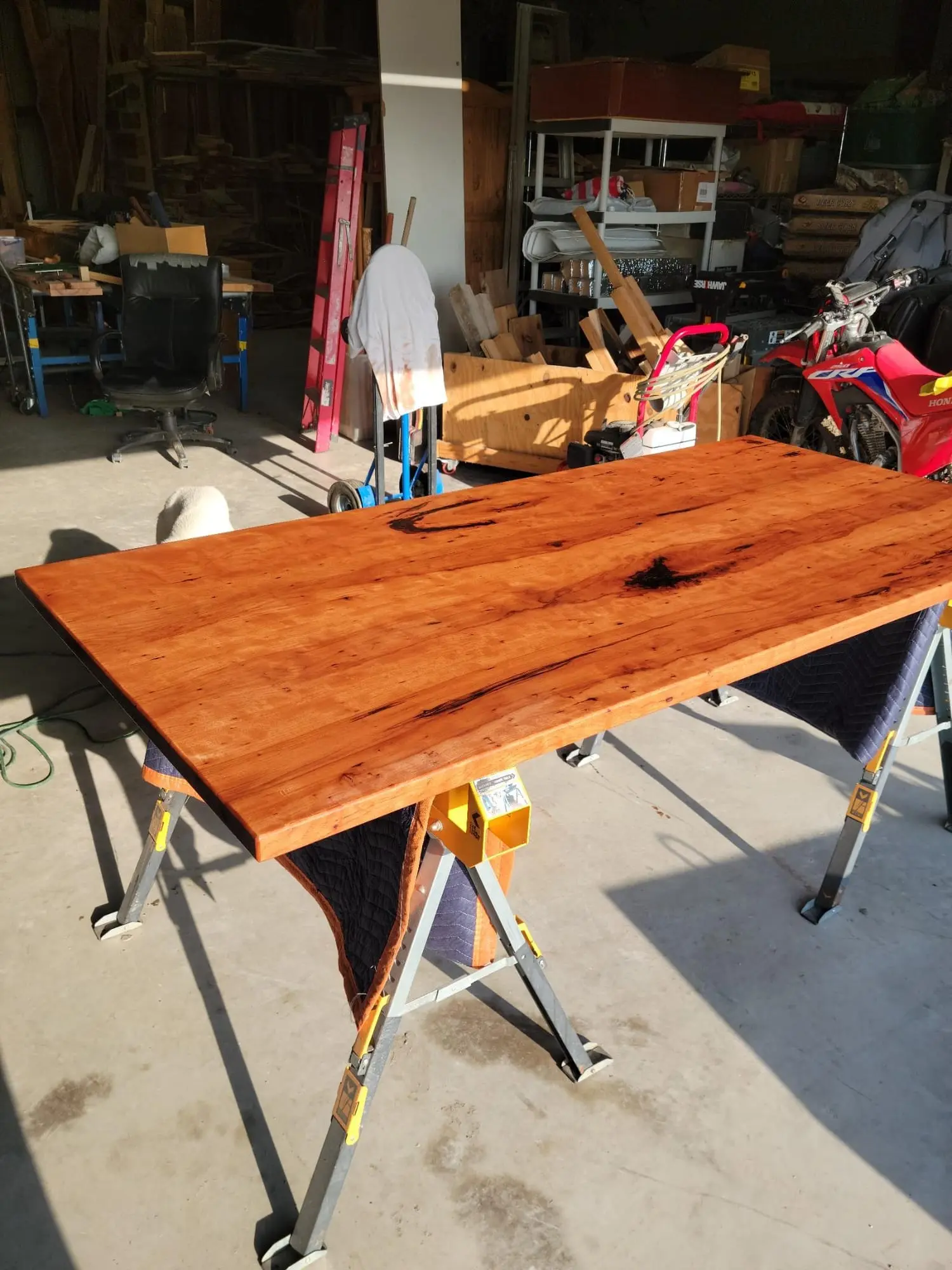
Open knots. We leave them, and where a knot needs it we fill with epoxy so the surface stays flat and cleanable. A knot is where a branch was. Removing every knot means throwing away most of the tree and building tables out of the boring part.
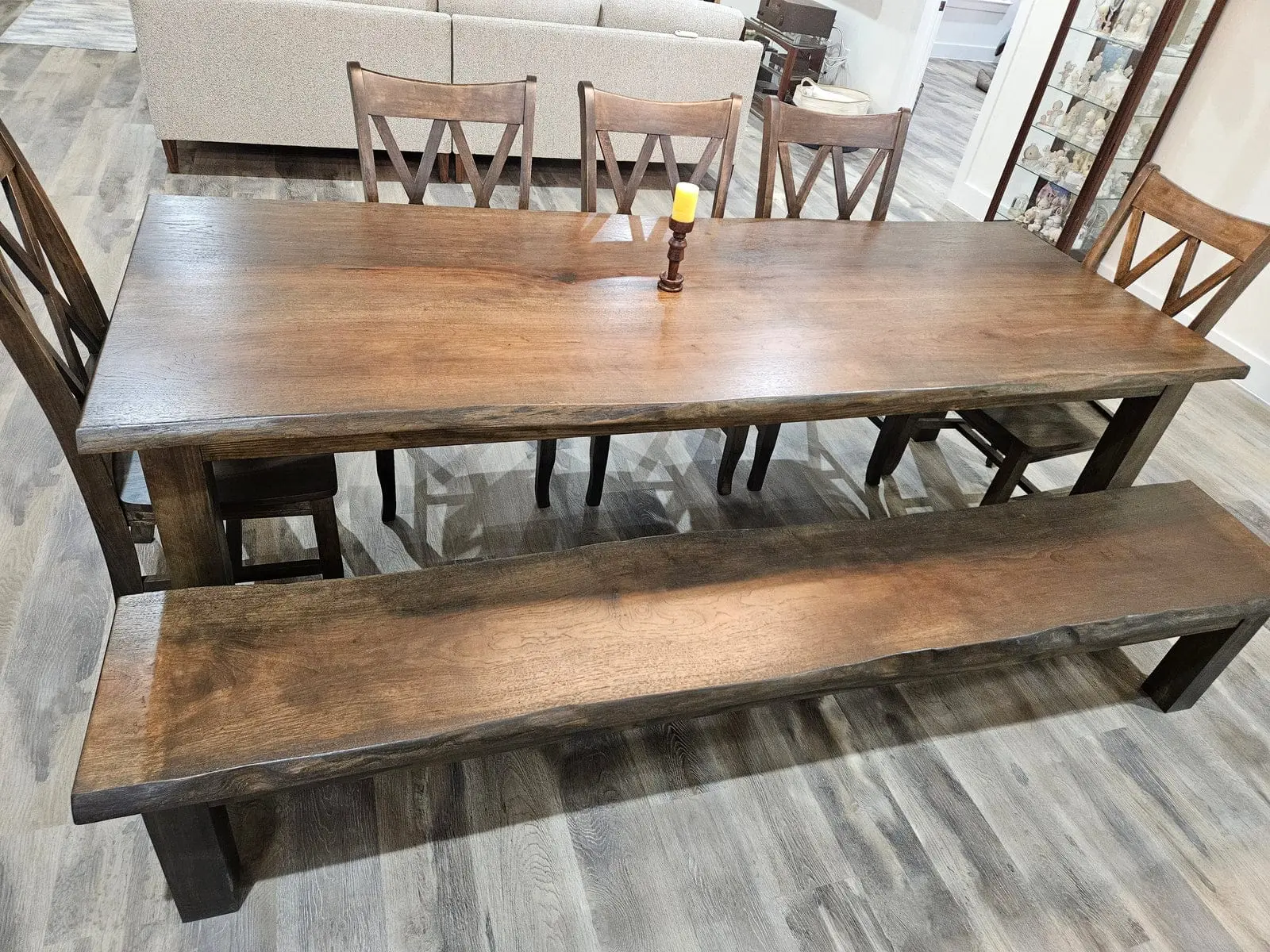
Stain variation. Board to board, and within a single board. Different growth rings absorb differently. Sapwood takes stain lighter than heartwood. Around a knot the grain swirls and drinks more, so it goes darker. On Red Oak especially, the open pores pool dark stain and create contrast, which is exactly why we like Red Oak with dark stains.
Color change over time. Walnut lightens with UV exposure. Cherry darkens dramatically. Maple ambers. If something sits in the same spot on your table for two years, you may see a shadow of it when you move it. Rotate your runner and centerpiece now and then.
Mineral streak and figure. Gray or green streaking in oak and maple, from minerals the tree pulled out of the soil. Not a defect. Frequently the best-looking board in the stack.
Distress marks. On pieces we build in a distressed style, those are deliberate. We will tell you before we do it.
Where we draw the line
None of the above means anything goes. There is a real difference between character and failure, and we own the difference.
What we consider a defect and will fix:
- A joint that has opened up or failed
- A top that is cupping, twisting, or bowing beyond normal
- A finish that is peeling, bubbling, clouding, or not cured
- Any structural looseness in a base, leg, or stretcher
- A crack that is running and growing, as opposed to a stable check
- Anything that makes the piece not do its job
What we consider character and will not "fix":
- Knots, including filled knots
- Stable checks and small end checks
- Mineral streak, sapwood, color variation between boards
- Stain absorbing unevenly across figure and grain
- Seasonal breadboard movement
- Saw marks or texture on a live edge, where the piece is meant to have them
- Natural color shift with age and light
What you can do
The honest answer is: control your humidity and you control almost all of this.
- Keep the house between roughly 35 and 55 percent relative humidity year round. A cheap hygrometer costs less than a tank of gas.
- Run a humidifier in winter if your heat dries the house out. This is the single biggest thing most people can do.
- Do not put the table over a floor vent or against a heat source.
- Wipe spills up. Standing water is the enemy, not humidity in the air.
- Use pads under hot dishes. Heat plus moisture is what clouds a finish.
Why we say all this up front
Because the alternative is furniture that does not move, and that furniture is made of MDF with a printed vinyl skin. It will be perfectly flat and perfectly uniform until the day the particleboard swells from a spill and the whole thing goes in the trash.
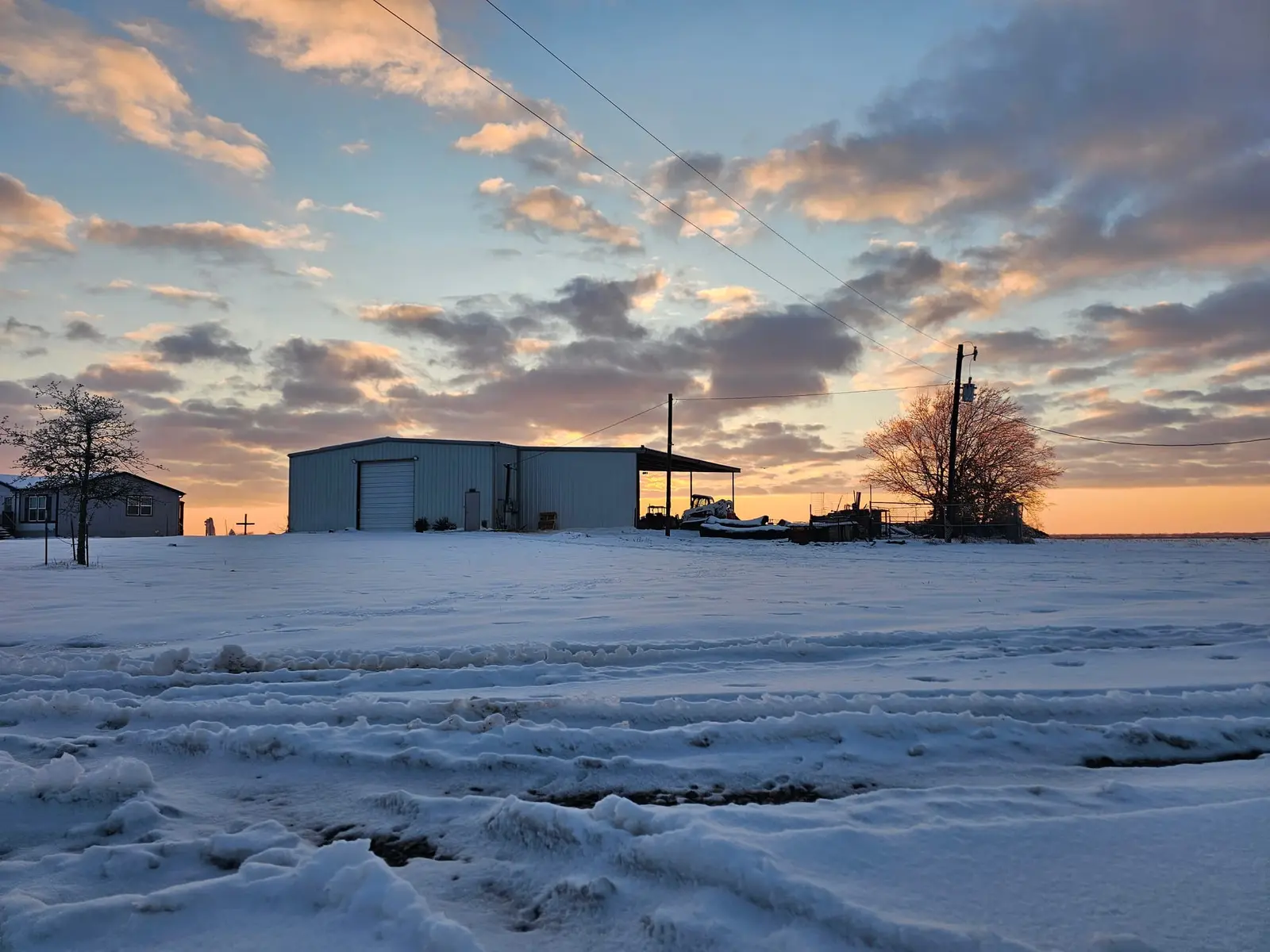
Our tables are made from trees we milled and dried ourselves, out here in Wolfe City. They shrink a little in the winter. They swell a little in the summer. Your grandkids will still be eating on them.
Questions about something you are seeing on a piece we built? Call 972-837-6974 or email hello@sawwwmill.com. Send a photo. We would much rather look at it than have you wonder.
While you are here
Every piece we build is made to order in your size, species, and finish, and every board in it was milled and dried here in Wolfe City. Build time runs 4–10 weeks.